NAIDOC Week
National Aboriginal and Islanders Day Observance Committee (NAIDOC)
First week in July
"National NAIDOC Week celebrations are held across Australia in the first week of July each year (Sunday to Sunday), to celebrate and recognise the history, culture and achievements of Aboriginal and Torres Strait Islander peoples.
NAIDOC Week celebrates and recognises the history, culture and achievements of Aboriginal and Torres Strait Islander peoples. It is an opportunity for all Australians to learn about First Nations histories and cultures and to participate in celebrations of the oldest, continuous living cultures on Earth.
It is an invitation to all Australians to connect with their local Aboriginal and Torres Strait Islander communities by attending activities and events hosted throughout the week.
History
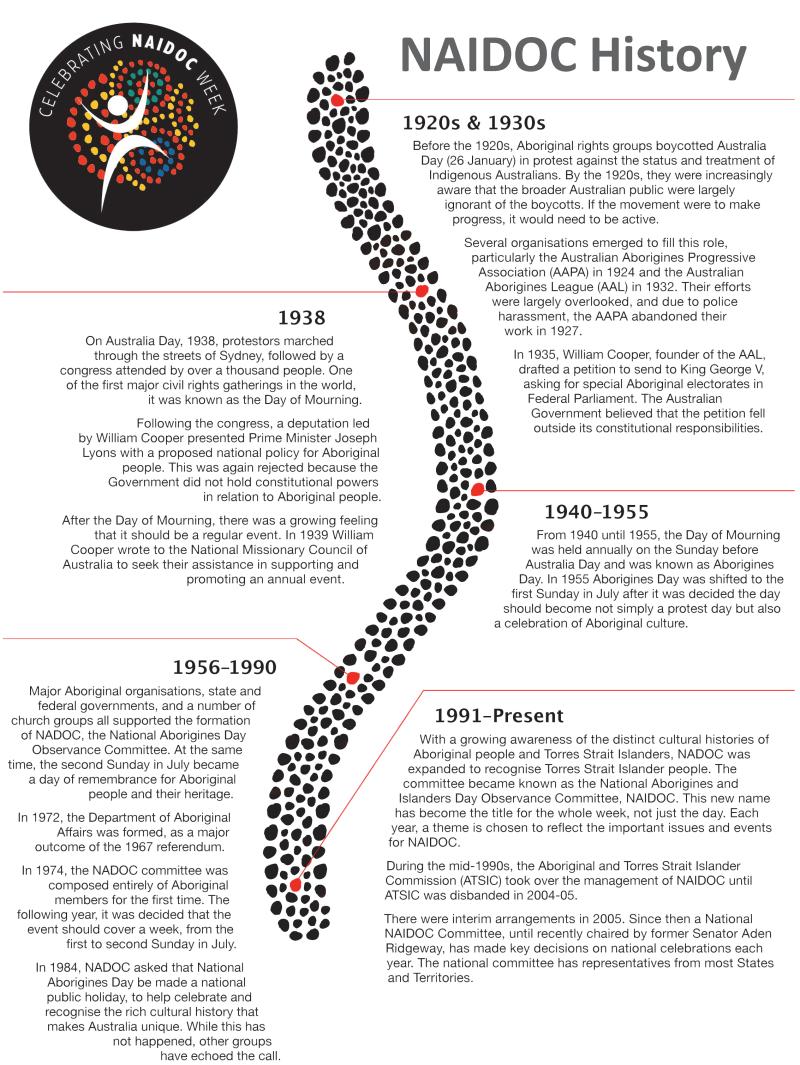
Before the 1920s, Aboriginal rights groups boycotted Australia Day in protest against the status and treatment of Indigenous Australians. By the 1920s, they were increasingly aware that the broader Australian public was largely ignorant of the boycotts. If the movement was to make progress, it would need to be active.
On Australia Day in 1938, protesters marched through the streets of Sydney, followed by a major civil rights gathering attended by more than a thousand people. It was known as the Day of Mourning, and it was a pivotal “first” for Indigenous rights activism, leading to increased calls for change that ultimately influenced the 1967 Referendum.
After the Day of Mourning, there was a growing feeling that it should be a regular event. In 1939, Aboriginal activist, community leader and founder of the Australian Aborigines League, William Cooper, wrote to the National Missionary Council of Australia to seek their assistance in supporting and promoting an annual event.
From 1940 until 1955, the Day of Mourning was held annually on the Sunday before Australia Day and was known as Aborigines Day. In 1955, Aborigines Day was shifted to the first Sunday in July, after it was decided the day should become not simply a protest day but also a celebration of Aboriginal culture. In 1975, it was decided that the event should cover a week, from the first to the second Sunday in July.
NAIDOC Week takes its name from the National Aboriginal and Islanders Day Observance Committee (NAIDOC), an independent, voluntary committee that coordinates the event nationally.
Each year NAIDOC promote a theme for that year's celebration.
A poster competition is held, and Educational Resources in support of the Australia Curriculum: Aboriginal & Torres Strait Islander Islander Histories and Culture cross-curriculum pr are made available.
the National NAIDOC Awards celebrating celebrate the outstanding contributions and excellence of Aboriginal and Torres Strait Islander peoples across ten (10) award categories, including art, culture, education and training, sport, environment and leadership. These Awards honour individuals and groups who inspire, lead, and create positive change in their communities and beyond.
Resources
NT Education Mob Digital Keeping Place - NAIDOC Week Posters - Browse over 50 years of the winners of the NAIDOC Week Annual Poster Competition
NT Education Mob Digital Keeping Place - NAIDOC Week Educational Resources - Find Teacher Resources, print or download from NAIDOC, ABC Learn and SBS. Links to interactive versions of the resources, including supplementary media materials.
NAIDOC Website - Learn about the National NAIDOC Committee, NAIDOC Week, themes, the National Poster Competition and Educational Resources. Download promotional material.
ABC Education - Aboriginal Torres Strait Islander Histories and Culture - Discover Teacher Resources and media materials and links to streamed programming from the ABC including material prepared specifically for NAIDOC week.
SBS Learn - Aboriginal Torres Strait Islander Histories and Culture - Discover Teacher Resources, media materials and links to streamed programming from SBS and NITV, including material prepared specifically for NAIDOC week.
Culture is Life - Education - curriculum resources , social impact campaigns and teacher training. All materials are developed by a collective of First Nations educators and young people.